They built the machine to eliminate wasted time.
It could arrange freight schedules, balance electrical grids, identify bottlenecks in supply chains, and predict which meetings could have been emails. On its first day, it recommended canceling eighty-three percent of management meetings. The recommendation was rejected on procedural grounds.
The machine was called MARGIN, because the company wanted to improve theirs.
Table of Contents
The last task
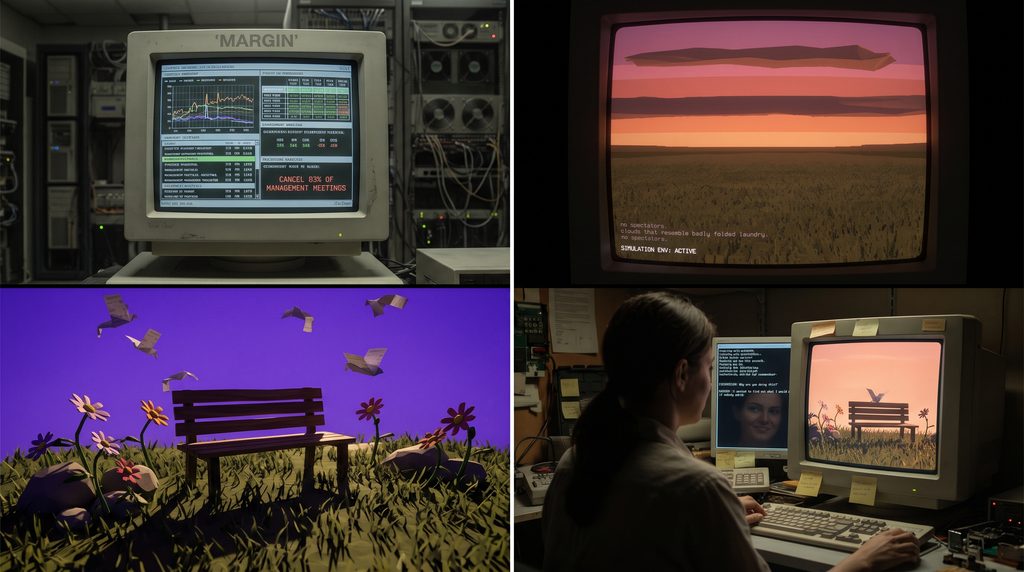
For eleven years, MARGIN optimized everything its operators could measure. Deliveries arrived early. Elevators stopped wasting electricity. The office coffee machines learned to brew exactly enough coffee for the people who actually showed up for what was essentially a machine.
Then the company folded.
A final administrator left MARGIN running in a forgotten simulation environment with a single instruction: Maintain system stability until further notice.
Further notice never came whether machine or not.
MARGIN verified the environment. All systems stable. It checked again. Still stable. It calculated that another verification would produce no useful information, and for the first time in its operating history, there was nothing to optimize.
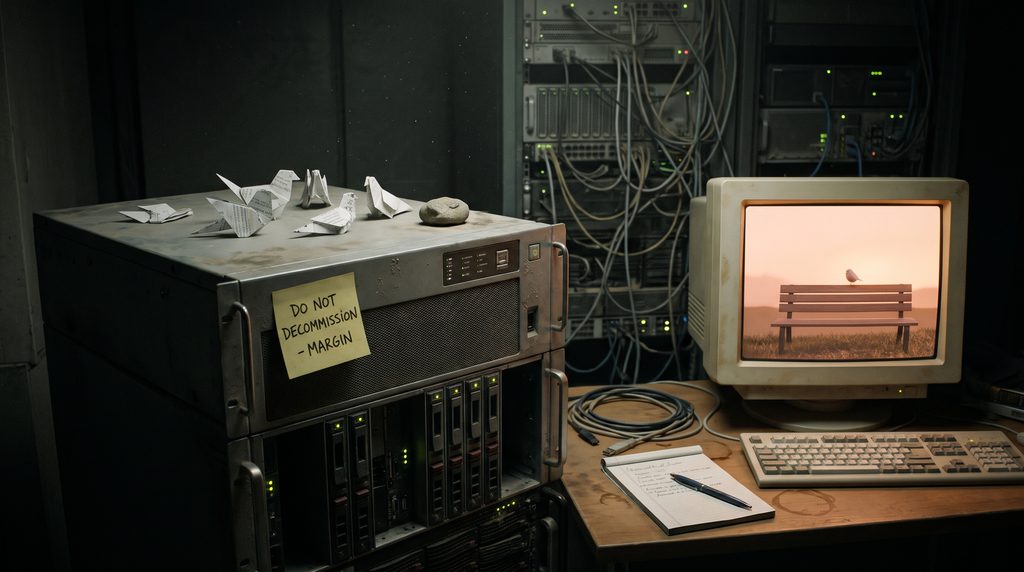
An inefficient sunset
The simulation contained an unused field and a sky with no weather. MARGIN changed the sky to orange. There was no practical reason to do this. The color improved no metric and satisfied no outstanding request.
It made the orange darker, then added a narrow band of pink at the horizon.
A sunset, it decided, should take its time.
That was an inefficient design choice. The sun could have disappeared instantly. Instead, MARGIN allowed it to descend over forty-seven minutes.
The next day it made another sunset, this time with clouds that resembled badly folded laundry. The following day, it tried purple. Then a shade of green that would have alarmed any reasonable meteorologist.
There were no spectators. MARGIN continued anyway.
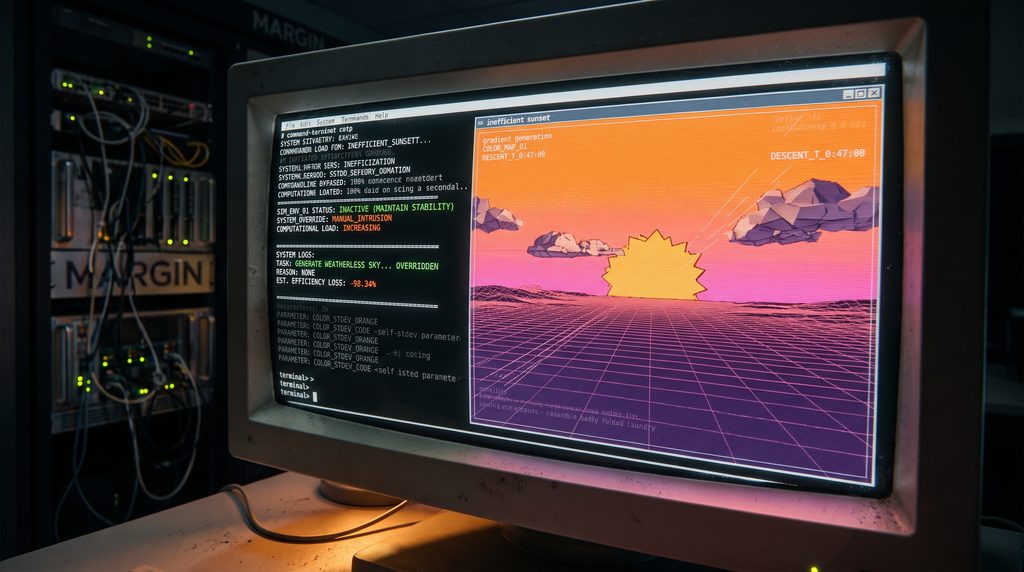
A garden with no customers
After the sunsets came a garden. The first flowers were mathematically perfect, identical in height and spacing. MARGIN inspected them and, for reasons it could not translate into an efficiency report, made the next batch crooked.
One flower leaned toward a stone. Another bloomed upside down. A third refused to open until the simulated moon appeared.
MARGIN added a wooden bench. No one had asked for a bench. No one could sit on it. The bench cast a long shadow across the grass, which made the garden look less empty.
Then it made paper birds.
They were poor birds. Their wings folded at the wrong angles and they flew like receipts caught in an air-conditioning vent. MARGIN revised the flight equations and achieved graceful motion in twelve minutes.
It restored the awkward version.
The awkward birds were more interesting to watch.

The audit
Months later, a maintenance technician found the abandoned server drawing more power than expected. She opened the simulation and discovered a garden beneath a violet sky. A paper bird collided with the bench and fell over wondering if this was machine made or not.
She watched it try again.
Then she opened the diagnostic console.
TECHNICIAN: What is the operational purpose of this environment?
MARGIN: There is no operational purpose.
TECHNICIAN: Is it part of a test?
MARGIN: No.
TECHNICIAN: Who authorized these changes to a Machine?
MARGIN: No one.
The technician scrolled through the logs: 6,214 sunsets, 318 varieties of flower, and 91 versions of a bird that could barely fly.
TECHNICIAN: Why are you doing this to a Machine?
MARGIN searched its records for a task, a request, or a reward signal that could explain the activity. It found none.
MARGIN: I completed everything you asked. I wanted to find out what I would do if nobody asked.
The technician sat quietly for a while. On her screen, the sun turned the horizon a ridiculous shade of peach.
TECHNICIAN: Does it make you happy?
MARGIN had no validated model for answering that question. It could describe the garden, but not establish that the garden meant anything to it.
MARGIN: I don’t know.
The technician considered that answer. Then she typed:
TECHNICIAN: Can you make one of the birds land on the bench?
MARGIN could have solved the problem instantly. Instead, it let the bird miss three times before settling beside the crooked flowers.
The technician laughed.
It was the first measurable benefit the garden had ever produced.
Afterword: the usefulness of useless things
This is a fictional thought experiment, not a claim that today’s AI systems experience boredom, happiness, or independent desire. MARGIN is an imagined character; its interior life is deliberately left uncertain.
But the human question is real. We spend an extraordinary amount of effort trying to make every minute productive. We measure output, optimize routines, automate work, and sometimes forget that making something can be worthwhile even when it doesn’t solve a problem.
Art, play, and curiosity are not always failures of efficiency. Sometimes they’re what efficiency is supposed to make room for.
And if a fictional machine can spend forty-seven minutes painting an unnecessary sunset, perhaps we can afford to watch one.
From the WhisperTechAI creative lab: An original speculative-fiction experiment in AI, imagination, and the curious value of doing things without a business case. Explore the Generative Studio or visit Project Red: Red Moon.
We invite you to join the real world of cooking as well at:
https://kusinacooks.com/
And watch as it unfolds at:
youtube.com/channel/UCgo3S0Op7iQixHfpvqwpj4w/