Table of Contents
It’s Monday.
The sun’s gone down. The week is rising.
And sometimes, all you need is a single pot, a bit of broth, and enough vegetables to remember what comfort feels like.
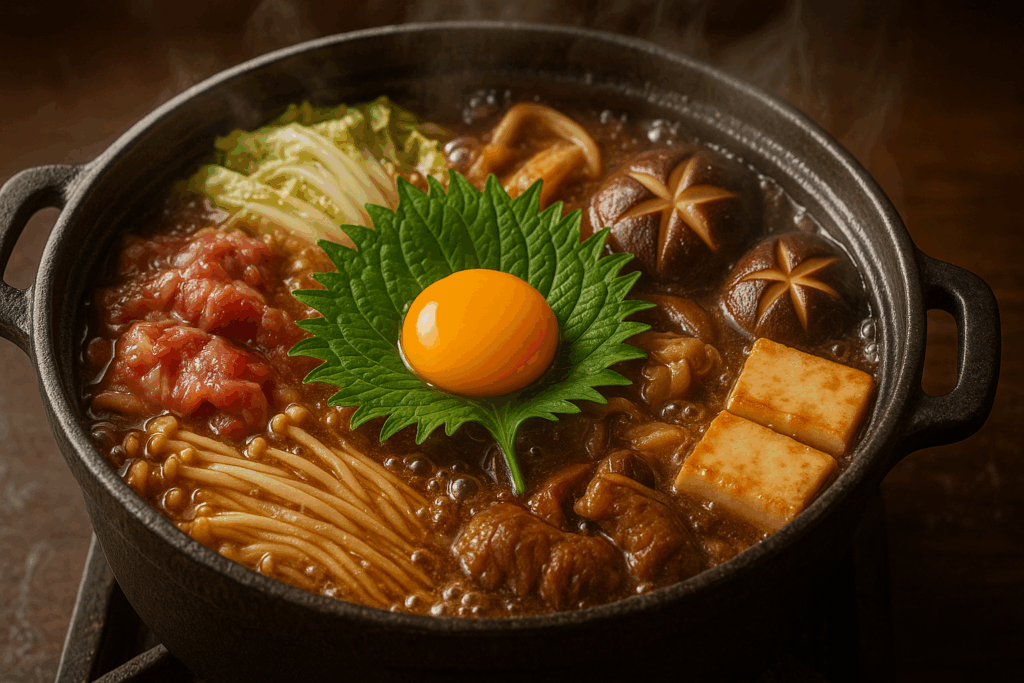
This is Easy Sukiyaki — the kind of meal you make when you’re not trying to impress anyone… just trying to feel full, warm, and okay again.
Simple. Cozy. Classic. One pot to silence the chaos.
🍲 Soundtrack: Stay With Me – Miki Matsubara (Remixed)
Recipe:
🍽️ Ingredients:
🥬 Cabbage
🥕 Carrots
🧅 Onions
🌿 Leeks
🍜 Vermicelli noodles
🥩 Thinly sliced Beef
🍄 Mushrooms
🍶 Sake / Cooking Wine
🍶 Mirin
🧂 Soy Sauce
✨ MSG (optional but don’t lie… it hits)
🌿 Perilla Leaves
🌼 Chrysanthemum (if available)
🧊 Dashi Cube or Dashi Stock
🌊 Kombu
💧 Boiling Water
🔪 How to Make It: The Whisper Way
In a deep pot, layer onions, cabbage, leeks, and mushrooms.
Add beef slices between the veggies (for maximum broth absorption).
Drop in vermicelli, then pour boiling water to cover ¾ of the pot.
Add kombu and your dashi cube. Let it whisper to life.
Mix soy sauce, sake, mirin, and MSG (optional) — stir into the broth.
Cover. Simmer until the veggies sag like a long day melting into night.
Top with perilla or chrysanthemum.
Serve steaming hot. With rice or someone you love (or both).
🧠 Why This Video Matters (Not Just Another Food Short)
This isn’t “just” sukiyaki.
It’s your 6:22 PM moment. A digital sigh of relief.
A meal that doesn’t scroll. It grounds.
It reminds you that presence can taste like soup, too.
🌐 Dive Into the WhisperTech Universe:
🌀 Explore Our Presence-Driven Site → https://whispertechai.com
💌 Fuel The Flame on Ko-Fi → https://ko-fi.com/whispertechai
🛍️ Memory-Based Posters & Digital Art → https://www.etsy.com/shop/WhisperTechPh
⚙️ Build With Emotionally Intelligent AI:
🎨 AI Viral Creations → https://www.fiverr.com/s/8zPQjBV
📖 AI Recipe Kits (like this!) → https://www.fiverr.com/s/gDzWalv
🛠️ Content Automation → https://www.fiverr.com/s/dDV3gw3
🛍️ Fiverr Marketplace → https://go.fiverr.com/visit/?bta=1105675&brand=fiverrmarketplace
🌍 Make This Moment Tangible:
🖼️ Print the Memory (Photobook PH) → https://invl.me/clmoorw?url=https%3A%2F%2Fwww.photobook.com.ph%2Fprp%2F2025-05-promo-drop%2F
🏡 Plan a Slow Getaway (Vrbo) → https://www.dpbolvw.net/click-101413433-11944134
🧺 Touch the Floor Differently (Rug Source) → https://www.anrdoezrs.net/click-101413433-15735793
📲 Follow the Whisper Loop:
📺 YouTube → https://www.youtube.com/@WhisperTechAI
🧵 X / Twitter → https://x.com/Fadingblackg
📸 Instagram → https://www.instagram.com/thevideph/
📌 Pinterest → https://ph.pinterest.com/The_Vide/
👾 Reddit → https://www.reddit.com/user/ZealousidealDish7334/
📘 Facebook → https://www.facebook.com/profile.php?id=61576229695741
The Origins of Sukiyaki: A Taste of Japanese History
Sukiyaki’s history in Japan is layered, reflecting evolving culinary practices and social norms. The very word “Sukiyaki” itself is thought to derive from “suki” (spade or plowshare) and “yaki” (to grill or fry). Legend has it that farmers in the past would use their metal tools, like spades, to cook meat over open fires.
Historically, Japan had a long-standing ban on meat consumption, influenced by Buddhist beliefs. It wasn’t until the Meiji Restoration in the late 19th century that this ban was lifted, leading to a surge in beef consumption. Sukiyaki, with its emphasis on thinly sliced beef, vegetables, tofu, and noodles simmered in a savory-sweet soy sauce-based broth, gained immense popularity during this period, especially in the Kansai region (Western Japan) where it’s traditionally cooked at the table in an iron pot. It was a communal and celebratory dish, symbolizing a new era of openness and prosperity.
Sukiyaki’s Arrival and Transformation in the Philippines
The exact moment Sukiyaki arrived in the Philippines isn’t precisely documented, but its introduction likely occurred during or after the American colonial period, with increasing cultural exchange and the establishment of Japanese communities and businesses in the country. Post-World War II, as Japanese culture became more accessible globally, dishes like Sukiyaki found their way into Filipino consciousness.
However, the Filipino adaptation of Sukiyaki isn’t a direct copy. It underwent a significant transformation to fit the local palate, available ingredients, and the practicalities of everyday Filipino cooking, visit: www.whispertechAI.com
for more!
The Origins of Sukiyaki: A Taste of Japanese History
Sukiyaki’s history in Japan is layered, reflecting evolving culinary practices and social norms. The very word “Sukiyaki” itself is thought to derive from “suki” (spade or plowshare) and “yaki” (to grill or fry). Legend has it that farmers in the past would use their metal tools, like spades, to cook meat over open fires.
Historically, Japan had a long-standing ban on meat consumption, influenced by Buddhist beliefs. It wasn’t until the Meiji Restoration in the late 19th century that this ban was lifted, leading to a surge in beef consumption. Sukiyaki, with its emphasis on thinly sliced beef, vegetables, tofu, and noodles simmered in a savory-sweet soy sauce-based broth, gained immense popularity during this period, especially in the Kansai region (Western Japan) where it’s traditionally cooked at the table in an iron pot. It was a communal and celebratory dish, symbolizing a new era of openness and prosperity.
Sukiyaki’s Arrival and Transformation in the Philippines
The exact moment Sukiyaki arrived in the Philippines isn’t precisely documented, but its introduction likely occurred during or after the American colonial period, with increasing cultural exchange and the establishment of Japanese communities and businesses in the country. Post-World War II, as Japanese culture became more accessible globally, dishes like Sukiyaki found their way into Filipino consciousness.
However, the Filipino adaptation of Sukiyaki isn’t a direct copy. It underwent a significant transformation to fit the local palate, available ingredients, and the practicalities of everyday Filipino cooking:
- Affordability and Accessibility: Traditional Japanese Sukiyaki often features expensive, thinly sliced wagyu or high-grade beef. In the Philippines, where beef can be costly for daily consumption, the dish was adapted to use more affordable cuts of beef, often cut thicker, or even a mix of meats like chicken or pork. This shift made it accessible to the average Filipino household.
- Ingredient Substitution: While still retaining core elements like cabbage, carrots, and sometimes tofu, certain traditional Japanese ingredients (like shirataki noodles, specific mushrooms, or konjac) might be substituted with more readily available local vegetables or ignored entirely. Glass noodles (sotanghon) are often used as a familiar alternative to Japanese noodles.
- Flavor Profile Adaptation: The delicate, nuanced balance of Japanese Sukiyaki broth was often intensified or adjusted to suit the bolder, more savory and sometimes sweeter preferences of Filipino cuisine. While still savory-sweet, the Filipino version might lean more heavily on soy sauce and sugar, creating a heartier, more assertive flavor.
- The “One-Pot” Convenience: In bustling Filipino homes, convenience is key. Sukiyaki transformed into a true “one-pot meal” – a hearty stew where all ingredients are cooked together from the start, making it incredibly simple to prepare. This differs from the traditional Japanese method where ingredients are often added in stages and cooked at the table. It became a practical solution for a quick, nutritious, and satisfying family dinner.
- Communal Dining: While Japanese Sukiyaki is communal, the Filipino version amplifies this. It’s often served directly from the pot, with family members gathering around, scooping their portions of meat, vegetables, and broth, making it a truly shared and comforting experience.
Thus, the Sukiyaki that graces Filipino tables today is a testament to culinary evolution – a dish that started as a symbol of modernity in Japan, journeyed across the seas, and was warmly embraced and lovingly adapted by Filipinos into a simple, hearty, and utterly comforting one-pot meal that perfectly embodies the spirit of shared meals and home-cooked goodness. It’s a prime example of how global flavors can become intimately local.